What Can You Store in a Self Storage Unit? The Complete UK Guide
SafeStorage Team · 29 September 2026
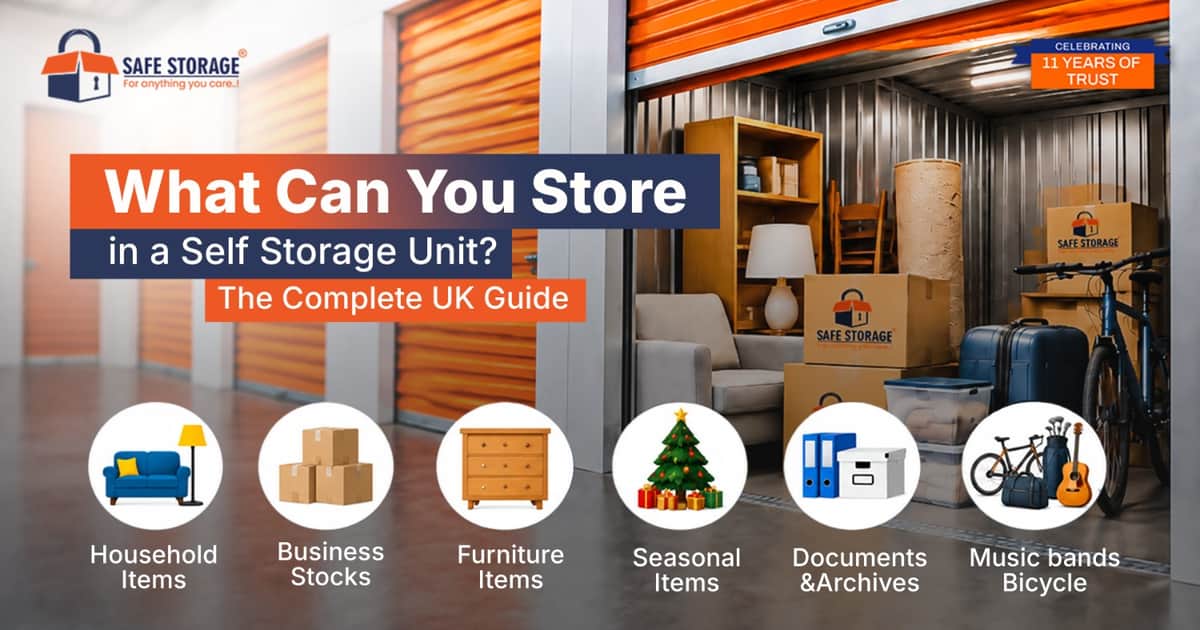
Almost everyone asks the same question before they book storage for the first time, and it is rarely the one about price. It is this one. Will they actually take my stuff?
It is a fair worry. Nobody wants to spend a Saturday wrapping a sofa, boxing up the loft and labelling everything, only to be told at the door that half of it is not allowed. So this guide runs through what goes into a self storage unit without any fuss, what needs a bit of preparation first, and the short list of things that no UK operator will take under any circumstances.
SafeStorage has been storing people’s belongings since 2015, first in India, then Dubai, and now across the UK. The pattern is the same everywhere. Most of what people hesitate about is perfectly fine. The genuinely awkward items are a much shorter list than anyone expects.
The short answer
If you are pushed for time, this is the whole guide in six lines.
1. Almost all household storage is fine. Furniture, beds, sofas, wardrobes, white goods, electronics, clothing, books, toys, garden furniture and boxes all go into a self storage unit without any special treatment.
2. Business stock and equipment are fine. Inventory, IT hardware, office furniture, exhibition kit and archive boxes are routine.
3. Document storage is fine, and is its own service. Business records need indexing and GDPR-compliant handling, so they sit slightly apart from ordinary household storage.
4. Some things need preparation. Fridges, washing machines, mattresses, garden tools and anything with a battery need draining, drying or emptying first.
5. A short list is banned outright. Anything flammable, explosive, perishable, living or illegal. No exceptions, anywhere in the UK.
6. When in doubt, ask before you pack. A two-minute phone call is much easier than repacking on the pavement.
Household items you can store
Household storage is the biggest single reason people book a self storage unit in the UK . House moves, renovations, a long trip abroad, a relationship ending, a parent’s home being cleared. The contents are broadly the same each time, and almost all of it is straightforward.
It helps to walk through the house room by room.
1. Living room
Sofas, armchairs, coffee tables, sideboards, bookcases, TV units, rugs, lamps, curtains, cushions and pictures. Large upholstered furniture is the bulkiest thing in most household storage jobs, and it is also the item most often damaged by bad handling rather than by storage itself.
Wrap upholstery in breathable covers rather than plastic sheeting. Plastic traps moisture against fabric and, over a long stay, that is how you get a musty sofa. Remove sofa legs where they unscrew. Take pictures out of the boxes they will be carried in and wrap glass separately.
2. Bedrooms
Beds, mattresses, wardrobes, chests of drawers, bedside tables, mirrors, bedding and clothing. Flat-pack wardrobes are worth dismantling. They were never designed to be carried assembled, and the joints are the first thing to fail on a stairwell.
Mattresses go into a self storage unit perfectly well as long as they are clean, completely dry and bagged. Store them flat if you can. Standing a sprung mattress on its side for months puts the springs under load they were not built for.
3. Kitchen
Fridges, freezers, washing machines, tumble dryers, dishwashers, microwaves, small appliances, crockery, glassware, pans and utensils.
White goods are fine, but they need real preparation. Defrost the freezer fully and let it dry out over a day, not an hour. Drain the washing machine and dishwasher hoses. Leave fridge and freezer doors slightly ajar or wedged if the design allows, because a sealed damp fridge left for six months is a mould problem waiting to happen. Empty every appliance completely. A forgotten jar in a fridge door has ruined more household storage than any other single mistake.
Crockery and glassware should be individually wrapped and packed upright in small boxes rather than laid flat in large ones. Plates stood on their edge survive far better than plates stacked.
4. Loft, garage and garden
Bicycles, tools, garden furniture, parasols, barbecues, camping gear, Christmas decorations, suitcases, paddling pools, children’s outdoor toys and general loft overflow.
Garden furniture must be clean and completely dry before it goes into a self storage unit. Rattan and timber that go in damp will not come out the same.
Barbecues need to be emptied, cleaned and, critically, separated from their gas bottle. The barbecue can be stored. The bottle cannot.
Petrol tools are a common sticking point. A lawnmower, strimmer or generator can be stored, but only with the fuel tank drained and the carburettor run dry. Nobody will take a mower with a full tank.
5. Children’s things
Cots, high chairs, prams, buggies, stair gates, toy boxes and outgrown clothing. Families keeping baby equipment between children is one of the most common long-stay household storage cases we see. Clean fabric parts and dry them thoroughly, because prams that go into storage slightly damp are a familiar disappointment a year later.
Furniture: what actually needs care
Furniture is where household storage most often goes wrong, and it is almost never the storage that causes it.
1. Solid wood. Expands and contracts with humidity. Climate controlled storage matters most for antique or veneered pieces, where a loose joint or a lifted veneer is expensive to repair.
2. Leather. Dries and cracks in heat, and can develop mould in damp. Wipe it down, use a leather conditioner before it goes in, and keep it off a cold concrete floor.
3. Glass. Table tops, cabinet doors and mirrors should travel separately, edge-protected and upright. Never lay glass flat under anything.
4. Flat pack. Dismantle it. Chipboard furniture assembled once and moved twice usually does not survive the second move.
5. Pianos and heavy items. These need specialist handling and advance notice. Do not assume they will fit on a standard collection.
Everything in a SafeStorage self storage unit goes into a climate controlled, CCTV monitored warehouse, which removes most of the environmental risk. Handling is the part that still needs doing properly.
Electronics and appliances
Televisions, monitors, computers, games consoles, speakers, hi-fi equipment, printers, routers, kitchen gadgets and power tools all go into a self storage unit without difficulty.
The three rules worth following:
1. Take the batteries out. Alkaline batteries left in a device for a year will leak and destroy the contacts. Remove them from every remote, toy, clock and tool.
2. Keep the original boxes if you have them. Nothing protects a television better than the packaging designed for it. If the box is long gone, use a purpose-made TV case rather than a blanket.
3. Store screens upright. A flat-screen laid down and loaded with anything on top will crack. Always vertical, always braced.
Loose cables are worth ten minutes of your time. Bag them, label them, and tape them to the device they belong to. The alternative is a box of anonymous black wires that you will curse in eight months.
Clothing, textiles and seasonal items
Clothing, shoes, coats, bedding, curtains, towels and fabric are all straightforward household storage, and they are the items people most often store badly.
Everything must be clean and dry. Not almost dry. Fully dry. A single damp towel packed in a sealed box will affect everything around it.
Use wardrobe boxes with a hanging rail for suits, coats and anything that creases. Fold knitwear rather than hanging it, because hangers stretch the shoulders over months. Avoid vacuum bags for natural fibres such as wool and down, since long-term compression flattens them permanently.
Seasonal rotation is one of the quietest and most sensible uses of a self storage unit. Winter coats and duvets go in for the summer, garden furniture and fans go in for the winter, and a small flat suddenly works properly all year.
Business stock, equipment and archives
Business use is growing faster than household storage in the UK, mostly because commercial rent per square foot bears no relationship to warehouse rent per square foot. Companies work out fairly quickly that they are paying office prices to store cardboard.
What businesses put into a self storage unit:
1. Stock and inventory, including seasonal overflow and e-commerce fulfilment lines
2. IT equipment, servers, laptops and networking hardware
3. Office furniture during a move, a refit or a shift to remote working
4. Exhibition stands, banners, display units and event kit
5. Marketing materials, samples and printed collateral
6. Tools, plant and site equipment for trades
7. Archive boxes and historical records
The practical difference between business and household storage is retrieval. A household customer might not touch their things for a year. A business may need a specific box on a specific day, which is why barcoded inventory and same-day retrieval matter far more in a commercial account.
Document storage and business records
Document storage deserves a section of its own, because it is not simply household storage with paper in it.
Legal files, HR records, financial reports, medical records, client files and contracts can all be stored, but a UK business storing personal data on paper is still the data controller for it. GDPR does not stop applying because the box left the building. That means proper document storage needs indexing, access control, an audit trail, and a defined retrieval process.
What good document storage looks like:
1. Barcoded and indexed at file level. Not "box 14 somewhere in aisle 3".
2. Access controlled and logged. You should be able to see who requested what and when.
3. Retrievable to a deadline. A solicitor needing a file for a hearing cannot wait a week.
4. Certified destruction at end of life. Shredding to BS EN 15713 with a certificate, not a skip.
5. Compliant facilities. ISO 27001 certification and ICO registration are the baseline questions to ask any document storage provider.
SafeStorage UK runs document storage as a distinct service for legal, healthcare, finance, government and education clients, with indexed files retrievable within twenty-four hours. If you are storing regulated records, ask for those specifics rather than accepting a general self storage unit.
One point worth making plainly, because it costs UK businesses money every year. Retention periods are not optional. Payroll records, tax records, employment files and client matter files all carry their own statutory minimums, and holding personal data for longer than you can justify is itself a breach. Good document storage helps you here rather than hindering you, because an indexed archive tells you exactly what is due for destruction and when. A stack of unlabelled boxes in a cupboard tells you nothing, which is how most organisations end up keeping everything forever out of caution.
If your business currently keeps archive boxes in an office corner, in a director’s garage or in a rented room you are paying office rates for, moving them into managed document storage usually costs less and reduces your risk at the same time.
Items people are surprised they can store
1. Motorcycles. Yes, with the fuel drained and the battery disconnected. SafeStorage UK does store motorcycles.
2. Bicycles and e-bikes. Fine. Remove and store the e-bike battery separately, as lithium cells are treated differently from the frame.
3. Musical instruments. Guitars, brass, drum kits and keyboards all store well in a climate controlled self storage unit. Loosen guitar strings slightly before a long stay.
4. Wine. Possible, but only in genuinely temperature-stable conditions, and worth declaring for insurance.
5. Artwork and antiques. Yes, with proper wrapping and a declared value. Never lean canvases against a wall unprotected.
6. Student belongings over summer. One of the most common short-stay uses of household storage in UK university cities.
7. Inherited household contents. Clearing a family home is rarely something you can do in one weekend. Storage buys the time to decide slowly.
Items that need preparation first
These are accepted, but not as they stand:
1. Fridges and freezers. Fully defrosted, cleaned, dried, emptied, door left ajar.
2. Washing machines and dishwashers. Hoses drained, drum dry, transit bolts refitted if you still have them.
3. Lawnmowers, strimmers, generators. Fuel tank drained and run dry.
4. Barbecues. Cleaned and emptied. Gas bottle removed and kept elsewhere.
5. Anything battery powered. Batteries out and stored separately.
6. Garden furniture and camping gear. Cleaned and completely dry, with no soil or damp fabric.
7. Vacuum cleaners. Emptied. An unemptied vacuum in long-term household storage is an unpleasant surprise.
What you cannot store in a self storage unit
This list is short, it is consistent across every reputable UK operator, and it is not negotiable. It exists for fire safety, insurance and law, not to be difficult.
1. Flammable and combustible materials. Petrol, diesel, paraffin, gas cylinders, propane, lighter fluid, solvents, paint thinners.
2. Explosives and ammunition. Including fireworks and firearms.
3. Chemicals and hazardous waste. Acids, pesticides, asbestos, industrial cleaning agents.
4. Perishable food. Anything that can rot attracts pests, and pests affect every customer in the building, not just you.
5. Living things. Plants and animals. Obvious, but it does get asked.
6. Illegal goods. Stolen property, controlled drugs, counterfeit stock, unlicensed items.
7. Waste. A self storage unit is not a skip, and disposal charges follow anyone who tries.
8. Cash, jewellery and irreplaceable documents. Generally excluded from cover and better kept with you or in a bank.
Paint is the one that catches people out on almost every house move. Half-used tins from the garage feel like household clutter rather than hazardous material, but they are classed as flammable and they will be turned away.
How much space will you actually need?
People consistently underestimate volume, because furniture packs much larger than it looks standing in a room.
1. Boxes only
Student belongings, decluttering, paperwork and seasonal items. A box-level plan covers this without needing a full room of space.
2. Studio or one bedroom
A bed, a sofa, a few boxes and a small amount of flat-pack furniture.
3. Two to three bedrooms
A full family home mid-move. Beds, wardrobes, sofa, dining set, appliances and thirty or forty boxes. This is the most common household storage size in the UK.
4. Four bedrooms and above
Larger family homes, or business stock and archive volumes.
SafeStorage UK prices from box-level storage upwards, with collection and return delivery included rather than charged separately. The most reliable way to size a self storage unit is to describe your inventory to someone who does this daily rather than guessing from a chart.
Insurance and declared value
Every item in storage should have a value attached to it, and most disputes come from people who never did this.
Go through your inventory before collection and note anything genuinely valuable. Artwork, antiques, jewellery you have decided to store anyway, specialist equipment, wine, instruments. Declare it. Standard cover usually has a per-item limit, and something worth several thousand pounds sitting inside a general household storage declaration is not properly protected.
Photograph high-value items before they are wrapped. It takes ten minutes and it settles any question later. SafeStorage UK includes insurance cover on stored goods, but the cover only reflects what you declared.
Five mistakes worth avoiding
1. Packing damp. The single most common cause of damage. Everything dries fully first.
2. Using huge boxes. Large boxes get filled with heavy things, then split or hurt someone. Heavy items go in small boxes.
3. Not labelling. Label the side, not the top, and write what is inside rather than which room it came from.
4. No inventory list. If you cannot say what went in, you cannot say what came out.
5. Underestimating the timeline. Short-term household storage becomes long-term storage far more often than people expect. Plan for that at the start and it costs less.
Not sure whether your items are accepted?
Tell us what you need to store and we will confirm it, size it, and quote it. Collection and return delivery are included on every SafeStorage UK plan. Get your free quote today.
Frequently asked questions
1. What can I store in a self storage unit?
Almost all household and business items. Furniture, appliances, electronics, clothing, boxes, garden equipment, business stock, IT hardware and archive files are all standard. The exclusions are flammable, explosive, perishable, living or illegal items.
2. Can I store a fridge or washing machine?
Yes. Defrost, clean, drain and dry them fully, and leave the door slightly open. Damp sealed appliances develop mould over a long stay.
3. Can I store a mattress?
Yes, provided it is clean, dry and bagged. Store it flat where possible rather than on its edge.
4. Can I store business documents?
Yes, and document storage is a separate service for good reason. Records containing personal data still fall under GDPR, so they need indexing, access control and a proper retrieval process rather than a general household storage arrangement.
5. Can I store a motorcycle?
Yes. The fuel tank must be drained and the battery disconnected. SafeStorage UK accepts motorcycles.
6. Why can I not store paint or petrol?
Both are classed as flammable materials. Fire regulations and insurance terms prohibit them in any self storage unit in the UK, without exception.
7. Do I need climate controlled storage?
For boxes of books and plastic garden furniture, not really. For leather, solid wood, electronics, artwork, instruments and documents on a long stay, it makes a real difference.
8. How long can I store for?
From a few weeks to several years. Check the minimum period and the notice required for retrieval before you book.
9. How do I get my items back?
With a full-service provider, you request delivery and it comes back to your door. With a traditional self storage unit you collect it yourself, which means arranging transport.
10. Is my property insured while in storage?
SafeStorage UK includes cover on stored goods. Declare anything of unusual value separately, since standard cover carries per-item limits.
11. What is the difference between household storage and business storage?
Mostly access. Household storage is usually stored and left. Business storage needs indexed inventory and fast retrieval, because a company may need one specific item at short notice.
12. What should I do if I am unsure about an item?
Ask before packing it. Two minutes on the phone is easier than unloading it again at the door.
Final thoughts
The honest summary is that a self storage unit will take almost everything you own. The prohibited list is short and it is mostly common sense once you see the reasoning behind it.
What separates a good storage experience from a frustrating one is not what you store. It is how it was prepared before it went in, whether anyone wrote down what was collected, and how easily you can get it back. Get those three right and household storage, business storage and document storage all become genuinely simple.
If you are moving, renovating, downsizing, travelling or simply out of room, storage lets you keep what matters without letting it take over the house..
Not Sure What You Can Store?
From furniture and appliances to business stock, documents and seasonal belongings, SafeStorage UK makes storing your things simple and stress-free.
Not sure if your items are accepted or how much space you need? Tell us what you want to store and our team will help you choose the right storage solution, confirm what is allowed and provide a clear quote.
Get your free storage quote today — with collection and return delivery included.