Moving Boxes: How Many You Need & How to Pack Them
SafeStorage Team · 21 September 2026
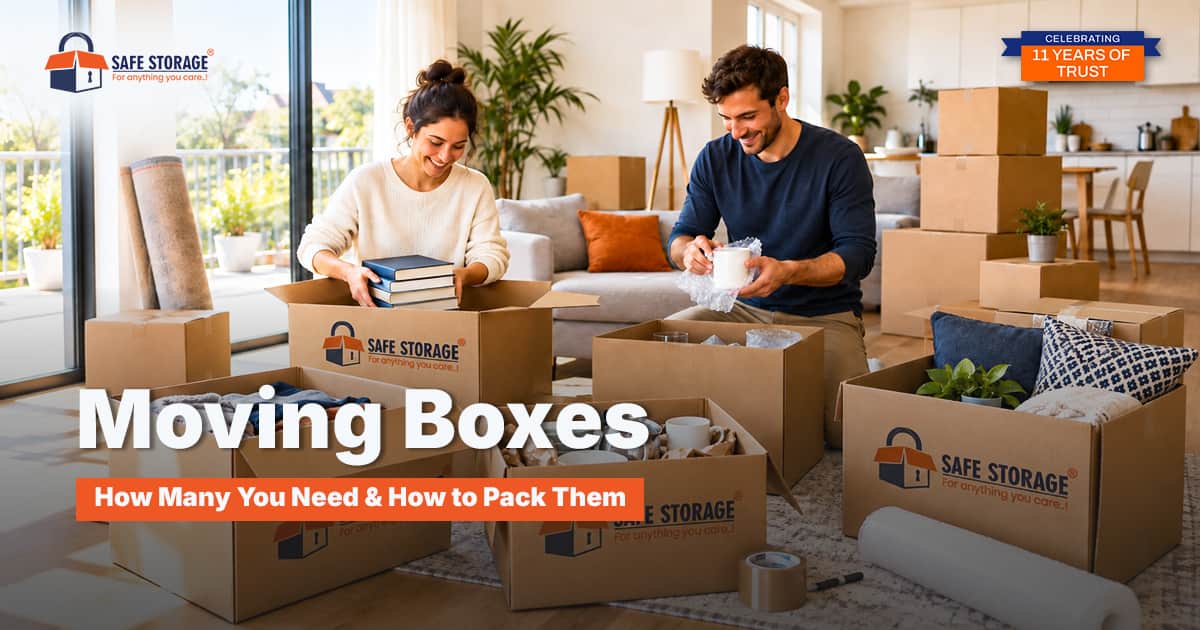
Every house move comes down to boxes. You can book the best removal firm in the country, but if your moving boxes are the wrong size, badly packed or unlabelled, you'll spend the first fortnight in your new place living out of a cardboard maze and searching for the kettle.
We've been in the storage and logistics business since 2015 and we've collected, stacked and delivered a genuinely absurd number of boxes over that time. Here's everything we've learned about getting this bit right, including the mistakes we see people make almost every single week.
How many moving boxes do you actually need?
Most people underestimate by about a third. Then they run out on the Friday night before the move and end up shoving clothes into bin bags at midnight.
Rough guide, based on what we typically collect:
-
Studio or one-bed flat: 25 to 35 boxes
-
Two-bed house or flat: 40 to 60 boxes
-
Three-bed house: 60 to 90 boxes
-
Four-bed house: 90 to 130 boxes
Those numbers assume a normal amount of stuff. If you've lived somewhere for a decade, add 20%. If you have children, add more again, because toys expand to fill whatever space you give them.
A useful shortcut: count your bookshelves. Every full metre of shelving is roughly two book boxes. Kitchens are the other surprise, usually eating 10 to 15 boxes on their own.
Order more moving boxes than you think you need. Unused flat-packed cardboard costs you a few pounds. Running out mid-move costs you a Saturday.
The three box sizes that actually matter
Ignore the twelve-option box catalogues. In practice you need three.
Small boxes (roughly 30 litres): For anything heavy. Books, tinned food, tools, crockery, vinyl records. The single most common packing error is putting heavy things in big boxes, which then can't be lifted, split at the seams, or hurt somebody's back.
Medium boxes (roughly 50 litres): Your workhorse. Kitchen items, toys, shoes, small appliances, general clutter. Most of your moving boxes should be this size.
Large boxes (roughly 80 litres): For light and bulky only. Duvets, pillows, cushions, coats, lampshades. Never books. Never anything with weight to it.
Two specialist extras earn their place. Wardrobe boxes with a hanging rail save you re-ironing every shirt you own. And dish barrels, which are double-walled, are worth it if you own glassware you'd be upset to lose.
Where to get moving boxes without overpaying
You have four options, and the right answer is usually a mix.
Buy new: Consistent sizes, clean, strong, and they stack properly. If you're putting things into storage for any length of time, this matters more than it sounds. Mismatched second-hand boxes don't stack squarely, and a leaning stack is a collapsed stack.
Supermarkets and shops: Ask at the customer service desk early in the morning, when deliveries have just been unpacked. Banana boxes are famously sturdy. The downside is that free boxes come in fifteen different sizes and some of them have been near food.
Buy-nothing groups and marketplace listings: Someone in your area moved last month and wants their cardboard gone. This is easily the cheapest route for a large volume of moving boxes.
Reuse your own: Anything that arrived by courier in the last year and got flattened rather than binned.
Whatever you use, check the base of every box before you fill it. Cardboard that's been damp, even once, has lost most of its strength and will fail exactly when it's full and halfway up a staircase.
Packing rules that survive contact with reality
Tape the bottom properly: One strip down the seam, then two more across it, forming an H. A single strip of tape is how boxes empty themselves onto driveways.
Heavy in small, light in large: Worth repeating because almost everyone gets it wrong at least once.
Fill every gap: Empty space inside a box means the contents move, and moving contents break. Screwed-up paper, tea towels, socks and jumpers all work as padding and need packing anyway.
Keep each box under about 18kg: If you can't comfortably carry it across a room, it's too heavy. Repack it.
Plates go on their edge, not stacked flat: Stacked plates crack under their own weight when the box gets jolted. Standing on edge, wrapped individually, they behave like records in a crate and survive far better.
Don't mix rooms: A box with kitchen bits and bathroom bits and a few books is a box you'll unpack three times.
Pack an open-first box: Kettle, mugs, tea, phone chargers, loo roll, hand soap, a knife, painkillers, and the tools for reassembling a bed. Mark it clearly and load it last so it comes off first.
Labelling: the ten minutes that saves you ten hours
Write on the side of the box, not the top. Once boxes are stacked, you can't see the tops.
On each side, put the destination room and three or four words about the contents. "Kitchen — pans, baking trays" beats "Kitchen" by a mile when you're hunting for one specific thing.
Add a number if you're organised, and keep a simple list on your phone. Box 34, kitchen, spice rack and utensils. When something goes missing, this list finds it in seconds.
Mark fragile boxes on every face, and mark anything going into storage differently from anything going straight to the new house. Colour-coded tape or a bold marker line is enough. Confusing those two piles is one of the most common problems we see on collection day.
When some of your boxes shouldn't come with you
Very few moves are clean handovers. Completion dates slip, chains wobble, the new place needs a floor sanded before furniture arrives, or you're simply downsizing and the new house won't swallow everything the old one held.
This is the gap we fill. Rather than paying for a bigger removal van and then living around stacked cardboard for two months, you send the surplus moving boxes and furniture straight into storage.
Our box storage plan starts at £24 a month and covers up to ten boxes, with free doorstep collection and free delivery back included. If you've got furniture as well, household storage is £89 a month for a room's worth, climate controlled and fully insured.
The part people appreciate most is that they don't hire a van. Our team arrives at your door, collects the boxes, and takes them away. When you're ready, you request them back through the portal or by phone and we deliver, with same-day retrieval available across most UK postcodes.
Everything sits in temperature and humidity controlled warehouses with 24/7 CCTV, and it's all covered by our insurance. You can cancel with seven days' notice, so you're not signing up for a year to solve a six-week problem.
Boxes at work: office moves and archives
Business moves follow exactly the same rules, just at greater volume and with more at stake.
If you're relocating an office, the boxes that cause trouble are always the archive ones. Old contracts, HR files, finance records, client paperwork. They're heavy, they're dull, and they somehow always end up stacked in a corridor.
Business storage handles the stock, IT kit and furniture side, with everything barcoded and tracked so it's retrievable rather than simply out of sight. For paperwork, document storage is the right route, because boxes of personal data carry obligations.
The Information Commissioner's Office is clear that physical records fall under the same data protection duties as digital ones, which covers how they're secured and how they're destroyed. Our document service is GDPR-compliant and ICO registered, with digital indexing, 24-hour retrieval and BS EN 15713 certified secure destruction.
Afterwards: don't just bin the cardboard
Once you've unpacked, you'll have a mountain of flattened moving boxes. Clean, dry cardboard is one of the easiest materials to recycle, and most UK councils take it kerbside if it's flattened and free of tape and polystyrene. Recycle Now has the local rules by postcode.
Better still, pass them on. Post them in the same local group you got yours from. Somebody two streets away is about to start this whole process.
Where we collect
We currently serve 12+ UK cities and add more each quarter: London, Manchester, Birmingham, Leeds, Edinburgh, Glasgow, Bristol, Liverpool, Sheffield, Nottingham and Cardiff, with Leicester coming soon.
-
Storage in London — collection across 10+ postcode areas
One last practical thing while you're packing: sort your post redirection before moving day rather than after. It's a five-minute job and it stops six months of bank letters going to strangers.
Frequently Asked Questions
1. How many moving boxes do I need for a house move?
Around 25 to 35 for a studio or one-bed, 40 to 60 for a two-bed, 60 to 90 for a three-bed, and 90 to 130 for a four-bed. Add roughly 20% if you've lived there for a decade or more, and add extra again if you have children. Most people underestimate by about a third, so it's worth ordering more than your count suggests.
2. What size moving boxes should I buy?
Three sizes cover almost everything. Small boxes of around 30 litres for heavy items like books, tools and tinned food. Medium boxes of around 50 litres for general household contents, which should make up most of your order. Large boxes of around 80 litres for light and bulky things only, such as duvets, pillows and coats. Wardrobe boxes with a hanging rail are a worthwhile extra if you have a lot of clothes.
3. How heavy should a moving box be?
Keep each box under about 18kg. A simple test: if you can't comfortably carry it across a room on your own, it's too heavy and you should repack it. This is why heavy things go in small boxes and light things go in large ones.
4. Can you collect my boxes, or do I need to hire a van?
We collect from your door. No van hire, no heavy lifting, and no trip to a storage facility. When you want your things back, request them through the online portal or by phone and we deliver, with same-day retrieval available across most UK postcodes.
5. How much does it cost to store moving boxes?
Box storage starts at £24 a month for up to ten boxes, with free collection and free delivery back included. If you have furniture as well, household storage is £89 a month for a room's worth, climate controlled and fully insured. Cancel with seven days' notice, so a six-week problem doesn't need a twelve-month contract.
6. How long can I store my boxes for?
A week or a year, whichever suits. There's no long lock-in, and you cancel with seven days' notice.
7. Are my boxes insured while in storage?
Yes. All items are covered under our comprehensive insurance as standard, stored in climate controlled warehouses with 24/7 CCTV and access control.
8. What should I do with the boxes after I've unpacked?
Flatten them, remove tape and any polystyrene, and most UK councils will take clean dry cardboard kerbside. Better still, post them in the same local group you got yours from, because somebody two streets away is about to start the whole process.
The short version
Order a third more moving boxes than you think you need. Use small boxes for heavy things and large boxes for light things. Tape the bottoms properly, fill every gap, label the sides, and keep an open-first box aside.
Separate what's going to the new house from what's going into storage before collection day, not during it.
Do that, and moving day becomes a logistics exercise rather than a crisis. Get everything else off your hands and let us collect the rest.
Get a free quote in two minutes and we'll call you back within two hours with a real price. More packing and storage guides are on the SafeStorage UK blog.